India's economy grew 5.4% year-on-year in the October-December quarter, slower than previous two quarters, government data on Monday showed, amid rising risks from higher prices of crude oil and commodities after Russia's invasion of Ukraine. The gross domestic product (GDP) expanded 20.1% in the April-June quarter and 8.4% in July-September, mostly because of weak performances in the same quarters in 2020 when the pandemic took hold. The National Statistical Office’s (NSO’s) second advance estimates for FY22 pegged the current fiscal year’s real gross domestic product (real GDP) growth at 8.9%, compared with 9.2% projected in the first advance estimates. "Real GDP or Gross Domestic Product (GDP) at Constant (2011-12) Prices in the year 2021-22 is estimated to attain a level of Rs 147.72 trillion, as against the First Revised Estimate of GDP for the year 2020-21 of Rs 135.58 trillion, released on 31.01.2022," said MoSPI.
There’s
an old theory that as an organism develops, it progresses through the
same evolutionary stages travelled by its ancestors. Traditionally,
economic development has worked in a similar way. When a country
first shifts from agrarian poverty to industrialization, it tends to
start out in light manufacturing, especially textiles. Later it
masters more complex manufactured products, and finally, it
progresses to inventing its own cutting-edge technology. Thus, each
country’s development tends to look a bit that of nations that
already went through the process.
That
certainly seems to describe the experience of South Korea and Taiwan,
which reached developed-country status relatively recently. It’s
also the path being followed by China. As these countries got richer
and their wages rose, low-tech labour-intensive manufacturing
industries tended to migrate to countries with cheaper workers.
Recently,
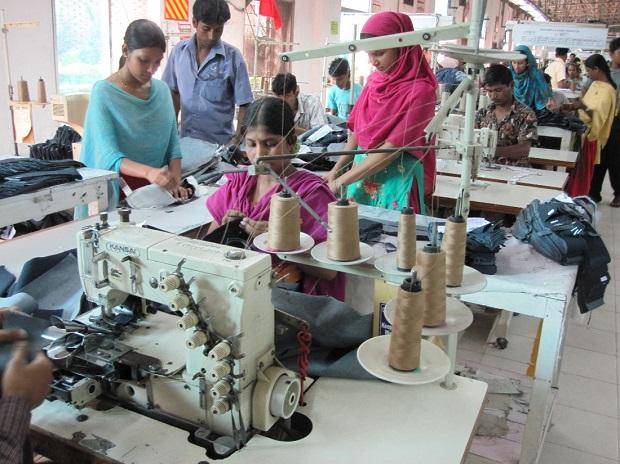
one of the biggest beneficiaries of this process has been Bangladesh.
The garment industry accounts for more than 80 per cent of the South
Asian nation’s export revenue, and about a fifth of its gross
domestic product. In 2017, Bangladesh was the world’s
second-largest apparel supplier after China, with 6.5 per cent of the
market, outpacing neighbouring India despite the latter’s much
larger economy.
This
economic development path has no doubt come at a real human and
social cost -- Bangladesh's workers suffer harsh working conditions
and many industrial accidents, including a horrific factory collapse
in 2013 that killed more than a thousand people. But overall, the
tried-and-true industrialization strategy seems to be working. Real
GDP per capita has doubled since the turn of the century, and
Bangladesh appears to be on a similar exponential growth path as its
neighbour India:
India,
meanwhile, has generally underperformed in manufacturing. The country
does have a few bright spots -- for example, it’s now the world’s
sixth-biggest auto manufacturer, with an immense factory cluster in
Gujarat,and has been increasing its production of smartphones...Read
More