Showing posts with label External Affairs Minister. Show all posts

Tuesday, June 25, 2019

From trade to Russia arms deals, Pompeo faces thorny issues on India visit

Company News

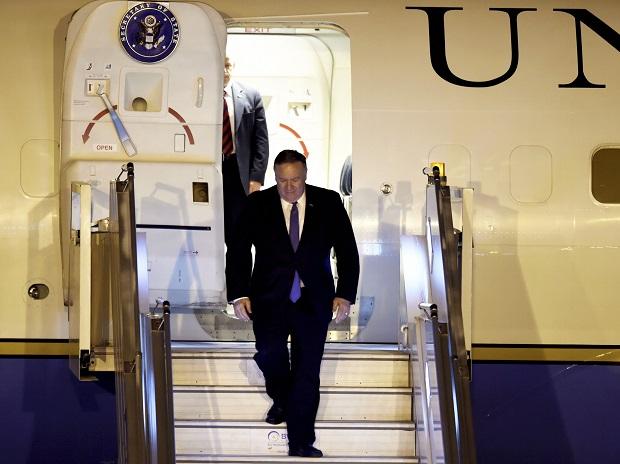
U.S. Secretary of State Mike Pompeo arrived on Tuesday for talks with Indian leaders in New Delhi, where he is expected to tackle a host of delicate issues from trade to India's longstanding defence and energy ties to Russia and Iran.Relations between the United States and India have improved dramatically since the Cold War but they have still fallen short of their promise and now have run into serious problems over tariffs, flows of data and tighter Indian rules on online commerce in one of the world's fastest growing large markets.
Pompeo landed in New Delhi late on Tuesday night after an unannounced trip to Kabul.
He will kick off his visit to India by calling on Prime Minister Narendra Modi who was re-elected for a second term last month with a powerful mandate that analysts say gives him the chance to take bold reforms to propel Asia's third largest economy towards faster growth.
BEFORE THE MODI-TRUMP TALKS
External Affairs Minister S Jaishankar and US Secretary of State Mike Pompeo will hold talks on Wednesday; Pompeo will later call on Prime Minister Narendra Modi
India’s data norms opposed by US digital majors, contentious trade issues, H1B visa, and terrorism are likely to come up for discussion
Pompeo’s visit comes ahead of the meeting between US President Donald Trump and Modi on the sidelines of the G20 Summit later this month

 Just ahead of his visit, New Delhi imposed tariffs on some U.S. goods after President Donald Trump's administration threw India out of a group of countries that were allowed duty free access for some of their products into the large U.S. market.

Thursday, June 6, 2019

People recognise India's stature in world has risen in last 5 yrs: EAM

International News

A large majority of people in India have recognised that the country's stature in the world has risen in the last five years, External Affairs Minister S Jaishankar said on Thursday.
Addressing a gathering at a seminar, Jaishankar said a "global rebalancing" is taking place and the "sharpest manifestation" of that is the rise of China and to an extent, the rise of India as well.
The former foreign secretary took part in the event days after taking charge of the ministry, a rare instance of a career diplomat handling the key portfolio as a minister.
"A large majority of people in India recognised that India's stature in the world has risen in the last five years," Jaishankar said.
He said the government has kept alive and perhaps even strengthened expectation of change in India.
The government looks different from outside than from inside, Jaishankar, who served as foreign secretary from 2015-18 said.
"We can build a closer region through regional connectivity projects," he added.
"If we want to propel economic growth, then there is greater responsibility for Indian foreign policy to focus on external aspect of it," the minister said.

 There is big responsibility on the External Affairs Ministry to focus on project execution which has strategic significance, he added.

Friday, March 1, 2019

India and Pakistan are both losing in the current confrontation

Current Affairs

Every aspect of the current confrontation between India and Pakistan -- which, I fear, may not be over yet -- was avoidable. The initial attack on Indian paramilitary soldiers, in which 40 of them died, was claimed by Pakistan-based Jaish-e-Mohammed, a terrorist group which has been allowed to thrive by that country’s military establishment. The attack itself required sophisticated organisation and hundreds of kilograms of explosives. Not preventing it was an Indian intelligence failure for which nobody has yet been held accountable.

After the attack, some form of retaliation was always on the cards, but the Indian government made the particularly risky choice of ordering airstrikes on a target within Pakistan proper. Although it claimed the strikes were a failure, Pakistan nevertheless chose to retaliate in turn. When it did, its front-line fighters had to be engaged by Indian warplanes that included the MiG-21, which many Indian aviation experts worry is too outdated for such duties. In the process, an Indian pilot was shot down and taken prisoner. While the pilot is being sent home, we in South Asia now live in a region in which two nuclear-armed adversaries send planes to bomb each other’s territory. This is a profoundly disturbing turn of events.


 Pakistan is busy congratulating itself on how things have turned out so far. This is unwise and premature. Premature because there is no reason to suppose that Indian Prime Minister Narendra Modi -- who on Thursday called the airstrikes a “pilot project,” implying they would be scaled up in the future -- will be satisfied with anything other than the total rhetorical victory his camp followers in the Indian media have already promised voters. And it is unwise because the world’s reaction to the Indian airstrikes, unprecedented though they were, was notably unfriendly to Pakistan. Pakistani leaders -- or, more precisely, the generals in Rawalpindi that really run the country -- have few friends left. Even the People’s Republic of China urged only that “sovereignty should be respected” -- criticism, in its way, of both sides and not just India.grouping to rescind the invitation to Swaraj...Read More