Showing posts with label Jaish-e-Mohammed. Show all posts

Wednesday, March 13, 2019

China blocks UN action against Masood Azhar; India expresses disappointment

Current Affairs

India Wednesday expressed disappointment soon after China blocked yet another move at the United Nations to designate Pakistan-based Jaish-e-Mohammed's chief Masood Azhar as a "global terrorist".
In its reaction, the External Affairs Ministry said India will continue to pursue all available avenues to ensure that leaders of terror groups involved in heinous attacks on Indian citizens are brought to justice.

"We are disappointed by this outcome. This has prevented action by the international community to designate the leader of Jaish-e-Mohammed (JeM), a proscribed and active terrorist organization which has claimed responsibility for the terrorist attack in Jammu and Kashmir on February 14," the MEA said.

Without naming China, it said the UN's 1267 Sanctions Committee was not able to come to a decision on the proposal for listing Azhar on account of a member placing the proposal on hold.
The JeM had claimed responsibility for the Pulwama attacks in which 40 CRPF personnel were killed.


 In yet another setback to India's bid to designate Azhar as a global terrorist, China put a technical hold on the proposal in the UN Security Council to ban him.

India, US corner Pak over terrorism, seek 'tangible, irreversible' action

Current Affairs

India and the United States sought "tangible and irreversible action" by Pakistan against terrorist groups and leaders, with the US national security advisor saying Washington stands shoulder-to-shoulder with New Delhi in its fight against terrorism.

The US support to India was expressed by American NSA John Bolton during a meeting with Foreign Secretary Vijay Gokhale on Wednesday.

"Met with Indian FS Gokhale to advance progress on the US-India strategic partnership & our shared vision for the Indo-Pacific, as well as reiterate that the US stands shoulder-to-shoulder with India in the fight against terrorism," Bolton said in a tweet.

Post the Pulwama attack by Pakistan-based Jaish-e-Mohammad, Bolton and US Secretary of State Mike Pompeo have emerged as strong supporters of the India-US relationship.

"Both underlined the importance of Pakistan taking tangible and irreversible action against terrorist groups based in territories under its control and denial of safe haven for these groups to launch cross -border attacks," the Indian Embassy said in a readout of the meeting.

However, the US support came on a day China for the fourth time blocked a bid to get Jaish chief Masood Azhar designated a global terrorist by the UN Security Council.


 China put a technical hold on the move by the US, the UK and France, seeking "more time to examine" the proposal, a diplomat at the United Nations has told PTI...Read more

Friday, March 1, 2019

India and Pakistan are both losing in the current confrontation

Current Affairs

Every aspect of the current confrontation between India and Pakistan -- which, I fear, may not be over yet -- was avoidable. The initial attack on Indian paramilitary soldiers, in which 40 of them died, was claimed by Pakistan-based Jaish-e-Mohammed, a terrorist group which has been allowed to thrive by that country’s military establishment. The attack itself required sophisticated organisation and hundreds of kilograms of explosives. Not preventing it was an Indian intelligence failure for which nobody has yet been held accountable.

After the attack, some form of retaliation was always on the cards, but the Indian government made the particularly risky choice of ordering airstrikes on a target within Pakistan proper. Although it claimed the strikes were a failure, Pakistan nevertheless chose to retaliate in turn. When it did, its front-line fighters had to be engaged by Indian warplanes that included the MiG-21, which many Indian aviation experts worry is too outdated for such duties. In the process, an Indian pilot was shot down and taken prisoner. While the pilot is being sent home, we in South Asia now live in a region in which two nuclear-armed adversaries send planes to bomb each other’s territory. This is a profoundly disturbing turn of events.


 Pakistan is busy congratulating itself on how things have turned out so far. This is unwise and premature. Premature because there is no reason to suppose that Indian Prime Minister Narendra Modi -- who on Thursday called the airstrikes a “pilot project,” implying they would be scaled up in the future -- will be satisfied with anything other than the total rhetorical victory his camp followers in the Indian media have already promised voters. And it is unwise because the world’s reaction to the Indian airstrikes, unprecedented though they were, was notably unfriendly to Pakistan. Pakistani leaders -- or, more precisely, the generals in Rawalpindi that really run the country -- have few friends left. Even the People’s Republic of China urged only that “sovereignty should be respected” -- criticism, in its way, of both sides and not just India.grouping to rescind the invitation to Swaraj...Read More

Terrorism due to distortion of religion, misguided belief: Swaraj tells OIC

Current Affairs

External Affairs Minister Sushma Swaraj on Friday raised the issue of terrorism at the Organisation of Islamic Cooperation (OIC) meeting and said the menace is caused by "distortion of religion" and "misguided belief".

Swaraj, who attended the inaugural plenary of the two-day meeting here as the guest of honour, said the fight against terrorism is not a confrontation against any religion.

"It cannot be," she said.

Swaraj's did not name Pakistan in the address.

"Just as Islam literally means peace, none of the 99 names of Allah mean violence. Similarly, every religion in the world stands for peace, compassion and brotherhood," Swaraj told the 57-member powerful grouping.

Her remarks came amid heighteneed tensions between India and Pakistan following the February 14 terror attack on Pulwama by Pakistan-based Jaish-e-Mohammed that left 40 CRPF personnel dead.
It is for the first time that India has been invited to a meeting of the OIC, an influential grouping of 57 Islamic countries, as the guest of honour.

Pakistan Foreign Minister Shah Mahmood Qureshi did not attend the meeting over the failure of the grouping to rescind the invitation to Swaraj.


 "Terrorism and extremism bear different names and labels. It uses diverse causes. But in each case, it is driven by distortion of religion, and a misguided belief in its power to succeed," she told the leaders of the major Muslim countries...Read More

Tuesday, February 19, 2019

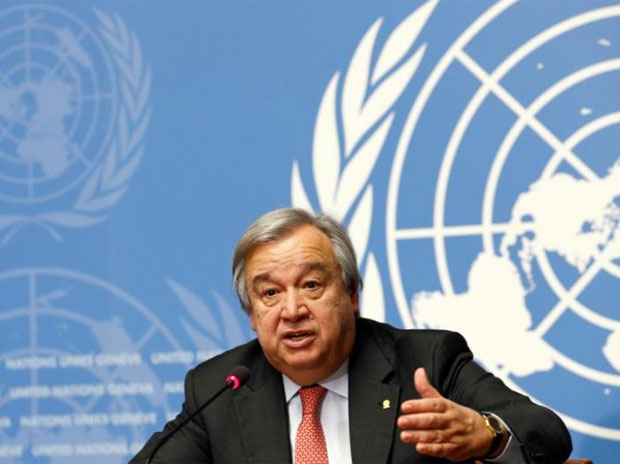
Pulwama attack: UN Secretary General calls on India, Pak to defuse tension

Current Affairs:

UN Secretary General Antonio Guterres has called on India and Pakistan to take "immediate steps" to deescalate tension that soared after 40 Indian security personnel were killed in an attack by Jaish-e-Mohammed in Pulwama.

"The Secretary General stresses the importance for both sides to exercise maximum restraint and take immediate steps to de-escalation, and his good offices are always available should both sides ask," the UN Chief's spokesperson Stephane Dujarric told reporters here Tuesday at the daily press briefing.

Dujarric was asked about a meeting Pakistan's Permanent Mission to the UN has sought with the Secretary General and also about Pakistani Foreign Minister Shah Mahmood Qureshi saying the UN must step in to defuse tensions between the two nations.
"...Looking at the situation in general between India and Pakistan, we're deeply concerned at the increase in tensions between the two countries in the wake of the attack on Indian security personnel on 14 February in Pulwama," Dujrraic said.

He said Pakistan's mission at the UN requested for the meeting with the Secretary General.
"We have seen press reports of a letter having been delivered to the UN. As far as we've ascertained, none has been received as of this very minute," he added.


 Last week, Guterres had "strongly" condemned the terror attack against security personnel in Jammu and Kashmir's Pulwama district, perpetrated by Pakistan-based terror group Jaish-e-Mohammed, calling for those behind the attack to be brought to justice...Read More

Thursday, February 14, 2019

Pak, China share the blame for Pulwama attack but India must introspect to

Current Affairs:

Millions of Indians will by now have seen the twisted wreckage of buses carrying dozens of Indian paramilitary soldiers from the Central Reserve Police Force, or CRPF; at least 40 of them died when a car loaded with explosives rammed into their convoy as it passed through Pulwama district of India’s Jammu and Kashmir state. Jaish-e-Mohammed, a group of militant Islamic extremists who pioneered suicide bombings in the disputed region of Kashmir, claimed responsibility for the attack. As one Kashmiri politician wrote on Twitter, it was “reminiscent of the dark days of militancy pre 2004-05.”

Jaish-e-Mohammed is based in Pakistan. Its leader, Masood Azhar, gives speeches freely and the group has built a sprawling training complex in the city of Bahawalpur, which features a wall painting of suitably militant-looking horses bearing down on Delhi’s Red Fort. Periodically, the Pakistani government pretends to crack down on militant Islamists such as Azhar; in fact, the terrorists continue to raise funds, recruit and strike at will across Pakistan’s borders. Nor is it just India that suffers. The Afghan government tells all and sundry that it cannot defeat the Taliban as long as the militants are supported by Pakistan. Just a day before the Kashmir attack, the Pakistan-based Sunni extremist group Jaish al Adl killed 27 members of Iran’s Revolutionary Guards, also using a car bomb.


 Pakistani officials often like to say that their country is among the foremost victims of Islamist terrorism. Perhaps. But, their response has been at best to accommodate extremism, and at worst to try and convince terrorists that their efforts are best turned outwards, towards India, Afghanistan or Iran. Indian government officials -- like the Afghans -- are caught in a bind. They have little leverage over the militants’ patrons within the Pakistani military establishment. Nor are the Americans any longer influential enough to help: Jaish-e-Mohammed went quiet in the mid-2000s at American insistence but reemerged soon enough.