Showing posts with label Moon. Show all posts

Monday, August 19, 2019

Chandrayaan 2 reaches Moon's orbit, is just days away from landing

Current Affairs

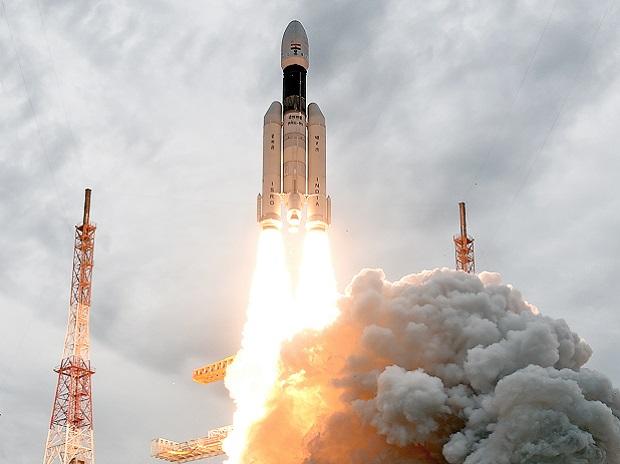
India's second Moon Mission, Chandrayaan 2, successfully entered the lunar orbit on Tuesday morning in a significant milestone that brings India closer to joining select nations that have explored the moon. Isro Chairman Kailasavadivoo Sivan had earlier described this event as a major challenge.
Lunar Orbit Insertion (LOI) manoeuvre was completed successfully today (August 20, 2019) at 0902 hrs IST, as planned, using the on-board propulsion system. The duration of the manoeuvre was 1,738 seconds. With this, Chandrayaan-2 was successfully inserted into a Lunar orbit. The orbit achieved was 114 km x 18,072 km.
The Indian Space Research Organisation (Isro) fired the spacecraft's liquid engine for a short while and placed it on a lunar bound orbit. From here, the spacecraft is scheduled to go through four more orbit manoeuvres to reach its final orbit passing over the lunar poles at a distance of about 100 km from the Moon's surface.Subsequently, the lander will separate from the Orbiter and enter into a 100 km X 30 km orbit around the Moon. Then, it will perform a series of complex braking manoeuvres to soft land in the South polar region of the Moon on September 7, 2019.
Chandrayaan-2 will attempt to soft land the lander Vikram, and rover Pragyan, in a high plain between two craters, Manzinus C and Simpelius N, at a latitude of about 70° south. The mission has 13 Indian payloads, including eight on Orbiter, three on lander and two on rover, and one passive experiment from US space agency NASA.

 The health of the spacecraft is being continuously monitored from the Mission Operations Complex (MOX) at Isro Telemetry, Tracking and Command Network (ISTRAC) in Bengaluru with support from Indian Deep Space Network (IDSN) antennas at Bylalu, near Bengaluru. All the systems of Chandrayaan-2 are healthy...Read More

Thursday, July 18, 2019

Women yet to step on moon but well intertwined with it in literature

International News

In the late 17th century, the female English playwright Aphra Behn wrote a smash hit play about a man obsessed with the moon, who was constantly travelling there in his imagination. Exactly 282 years later, Neil Armstrong and Buzz Aldrin actually made that dream a reality.
Their astonishing achievement on July 20, 1969 led some to worry that the moon would become an object of purely scientific study – a barren and lifeless body, no longer a source of romantic inspiration. Fortunately, this fear did not come to pass.
For example, in the year that marked the 40th anniversary of the landings ten years ago, the then poet laureate Carol Ann Duffy edited To the Moon: An Anthology of Lunar Poems which gathered together works from ancient to modern, and included her own poem, The Woman in the Moon.
And while no woman has yet stepped on to this celestial body, women have long been associated with the moon – with its tidal pull, and the binary thinking that places it secondary in majesty to the sun. It is no wonder, then, that the moon has stimulated some incredible literature by female writers.
The moon is often envisaged as a female entity, which inspired poems on the theme of her gaze as she looks down on Earth benignly. Way back in antiquity, the Greek poet Sappho did just this in her short song describing how:
When, round and full, her silver face, Swims into sight, and lights all space.

 This trope continued for millennia and into the 19th century. Louisa May Alcott (author of Little Women) wrote The Mother Moon in 1856, imagining a benevolent maternal moon looking down on the Earth, occasionally hidden but ultimately undiminished by clouds...Read More

How big is moon and how far is it? Let's put facts into perspective

International News

Even though we can see the Moon shining brightly in the night sky – and sometimes in daylight – it’s hard to put into perspective just how large, and just how distant, our nearest neighbour actually is.
So just how big is the Moon?
The Moon passing in front of Earth, captured by the Earth Polychromatic Imaging Camera (EPIC), more than a million kilometres away from our planet.
That answer isn’t quite as straightforward as you might think. Like Earth, the Moon isn’t a perfect sphere. Instead, it’s slightly squashed (what we call an oblate sphereoid). This means the Moon’s diameter from pole to pole is less than the diameter measured at the equator.
But the difference is small, just four kilometres. The equatorial diameter of the Moon is about 3,476km, while the polar diameter is 3,472km.
To see how big that is we need to compare it to something of a similar size, such as Australia.
From coast to coast
The distance from Perth to Brisbane, as the crow flies, is 3,606km. If you put Australia and the Moon side by side, they look to be roughly the same size.
The Moon vs Australia. NASA/Google Earth

 But that’s just one way of looking at things. Although the Moon is about as wide as Australia, it is actually much bigger when you think in terms of surface area. It turns out the surface of the Moon is much larger than that of Australia.The land area of Australia is some 7.69 million square kilometers...Read More

50th anniversary of Apollo 11: How we came to know a lot about the Moon

International News

The Moon has been a subject of fascination since time immemorial. It has always found a place among all kinds of stories through astrology, poetry, myths, religion et al. More than two and a half millennia before man set his foot on the Moon, he set his mind towards understanding it.
There are references in the works of ancient Babylonian, Greek, Indian and Chinese philosophers around 500 BCE. Throughout the next two thousand years, the Moon was studied by various astronomers. The big breakthrough, however, happened in 1609, when Galileo Galilei drew one of the first telescopic drawings of the Moon in his book Sidereus Nuncius and noted that it was not smooth but had mountains and craters. After Isaac Newton discovered gravitation, astronomy picked up speed. Over the next few centuries, science not only devised means of looking at faraway objects clearly, but also started dreaming of travelling to them one day.
Here's a brief timeline of the landmark moments of lunar exploration in modern times:
The Space war era
During the late 1950s at the height of the Cold War, the United States Army conducted a classified feasibility study that proposed the construction of a manned military outpost on the Moon called Project Horizon with the potential to conduct a wide range of missions from scientific research to nuclear Earth bombardment. The study included the possibility of conducting a lunar-based nuclear test.
1959: Soviet Union touches the Moon

 The Moon was first visited by the Soviet Union’s uncrewed Luna 1 and 2 in 1959..Read More

Thursday, July 11, 2019

Explore first moon landing in your living room with Google's 3D re-creation

International News
Imagine sitting in your living room and seeing a 3D re-creation of Apollo 11 rocket's command module that first took astronauts to the moon. Ahead of the upcoming 50th anniversary of mankind's first successful trip to the moon, Google has recreated the module with Augmented Reality (AR).
Users would get to explore 20 new stories about lesser-known aspects of the mission and the people who contributed to it, Google said in a blog post.
To celebrate the milestone, when users would Google search Apollo 11 on an AR-enabled device, they would see an AR option in the Knowledge Panel and tapping on it would let users explore a 3D recreation of the command module, Engadget reported on Wednesday. You can also zoom in and out to explore the historic event in all angles.
Explore first moon landing in your living room with Google's 3D re-creation
“On the anniversary of the Moon landing, we’re bringing you new ways to learn about this milestone of human achievement, including new perspectives and stories that celebrate the lesser-known figures who made it happen,” the blog post added.
It also plans to recreate an AR option with Neil Armstrong's spacesuit that would let users understand what astronauts wore on the surface of the Moon.
According to Google, this is the first time it has added a cultural artefact in AR feature on Search, which debuted in May.The search-engine giant has teamed up with the Smithsonian National Air and Space Museum for this project.

 More features such as moon- and space-related tours and quizzes on Google Earth have also been lined up from July 15...Read More

Tuesday, June 18, 2019

Space ethics? Five questions for how we choose to use the moon

Company News
The Moon has always served as an inspiration for humanity, and there are many potential benefits for further exploration of our planet’s rocky satellite.
But we need to establish guidelines to prevent unethical behaviour on the Moon, particularly regarding the use of natural resources and off-planet labour.
How humans should interact with space and celestial objects is central to the emerging field of space ethics. It’s something I’ve been involved with since 2015, when I taught my first class on consent for the use of celestial objects at Yale University’s Summer Bioethics Institute.As we prepare to celebrate the 50th anniversary of the Moon landing, here are five things we need to reflect on regarding ethical considerations for various future uses of the Moon.
1) Human settlement on the Moon
Some people believe establishing human settlements on the Moon – and other bodies – may help lessen the environmental burden of overpopulation on Earth. While the practical issues of survival and maintaining communication receive a lot of attention in discussions of Moon settlements, the ethical considerations are often overlooked.These include whether Moon-based humans would have the same legal and human rights as their counterparts on Earth. Would children born on the Moon even share the citizenship of their parents, or would they be stateless on Earth? And would they have a different physiology to Earth-born humans due to the reduced gravity on the Moon? A new breed of Moonians? Moonlings?

 We need to consider the complexities of establishing independent governance of a Moon base to promote the development of a fair society for those living there...Read More

Shadows on the Moon: A tale of ephemeral beauty, humans and hubris

Company News
Between 1969 and 1972, a new type of archaeological site was created. For the first time, human bodies and the technology needed to sustain them altered the landscape of another world. The astronauts from the six Apollo missions left a suite of space-age artefacts behind on the lunar surface. And not only that: the missions brought to the Moon new kinds of shadows, cast by machines and bodies and flags and rovers, in an interplay of movement and stillness.
On Earth, the movement of living things, the changing of the environment, both natural and cultural; and the weather, which occludes sunlight to different degrees, make shadows very dynamic. Lunar shadows, however, are more passive at human time scales, their movement identical with the fortnightly passage of the Sun over the surface.
The Apollo missions brought shadows that were not so passive. The speed of the shadows differed, depending on the activity being carried out, and was much faster than the slow passing of the day. Some shadows were solid black and some were lacy and textured, reflecting the mesh on the umbrella-shaped antennas.
They crossed and uncrossed with the angle of the Sun and the movement of the astronauts around the tiny landscapes that constituted their lunar experience. The shadows were captured and frozen in many photographs of the Apollo missions; in these photos, they became another type of artefact.
The Apollo 17 lunar rover and its shadows. NASA

 And then some shadows left, never to return, and others stayed to be swallowed by the lunar night and emerge into day again. The shadows of the objects left behind - descent modules, rovers, cameras and other equipment - will continue to be cast over the lunar surface until they decay in tens, hundreds or thousands of years. The objects don’t move, but their shadows circle them in diurnal devotion, sundials without a mission.

Wednesday, May 22, 2019

Moon mystery solved; massive impact behind two different faces: Study

Current Affairs

Collision with a wayward dwarf planet may have caused the stark difference between the Moon's heavily-cratered farside and the lower-lying open basins of the Earth-facing nearside, according to a study.

The mystery of the Moon's two faces began in the Apollo era when the first views of its farside revealed the surprising differences, according to the study published in Journal of Geophysical Research: Planets.

Measurements made by the Gravity Recovery and Interior Laboratory (GRAIL) mission in 2012 filled in more details about the structure of the Moon -- including how its crust is thicker and includes an extra layer of material on its farside.

There are a number of ideas that have been used to try and explain the Moon's asymmetry.
One is that there were once two moons orbiting Earth and they merged in the very early days of the Moon's formation, researchers said.Another idea is that a large body, perhaps a young dwarf planet, found itself in an orbit around the Sun that put it on a collision course with the Moon.

This latter giant impact idea would have happened somewhat later than a merging-moons scenario and after the Moon had formed a solid crust, said Meng Hua Zhu, from Macau University of Science and Technology.

Signs of such an impact should be visible in the structure of the lunar crust today.

"The detailed gravity data obtained by GRAIL has given new insight into the structure of the lunar crust underneath the surface," Zhu said.

 The new findings from GRAIL gave Zhu's team of researchers a clearer target to aim for with the computer simulations they used to test different early-Moon impact scenarios...Read More