Showing posts with label US China trade war. Show all posts

Thursday, December 12, 2019

'They want it': Trump approves US-China trade deal to halt Dec 15 tariffs

Election News
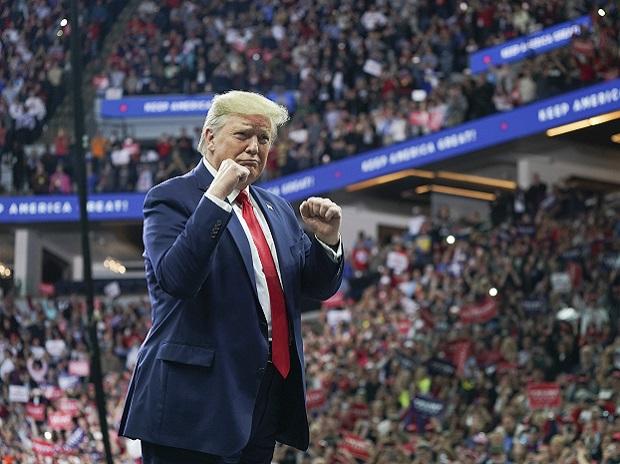
President Donald Trump signed off on a phase-one trade deal with China, averting the Dec. 15 introduction of a new wave of U.S. tariffs on about $160 billion of consumer goods from the Asian nation, according to people familiar with the matter.
The deal presented to Trump by trade advisers Thursday included a promise by the Chinese to buy more U.S. agricultural goods, according to the people. Officials also discussed possible reductions of existing duties on Chinese products, they said. The terms have been agreed but the legal text has not yet been finalized, the people said. A White House spokesperson declined to comment.
The administration has reached out to allies on Capitol Hill and in the business community to issue statements of support once the announcement is made, they said. Before meeting his trade advisers, Trump engaged with members of the Business Roundtable, which represents some of the largest U.S. companies, people said.
Global stocks hit a record high and bond yields climbed on optimism over trade. On Thursday, Trump tweeted that the U.S. and China are “VERY close” to signing a “BIG” trade deal, also sending equities higher. The yuan surged the most in a year.
“They want it, and so do we!” he tweeted five minutes after equity markets opened in New York, sending stocks to new records.

Trump changed his mind on deals with China before. Negotiators have been working on the terms of the phase-one deal for months after the president announced in October that the two nations had reached an agreement that could be put on paper within weeks.The U.S. has added a 25% duty on about $250 billion of Chinese products and a 15% levy on another $110 billion of its imports over the course of a roughly 20-month trade war...Read More

Monday, December 2, 2019

China preparing blacklist of US companies, signaling threat to trade talks

International News
Chinese state media said the government will soon publish a list of “unreliable entities” that could lead to sanctions against US companies, signaling that trade talks between the two nations are increasingly under threat from disputes over human rights in Hong Kong and Xinjiang.
The Communist Party-backed Global Times said in a tweet early Tuesday that the list was being sped up in response to a bill sponsored by Republican Senator Marco Rubio requiring measures against Chinese officials involved in alleged abuses of Uighur Muslims in the far west region of Xinjiang.
Beijing has threatened to publish such a list of companies since May, after the US placed restrictions on Huawei Technologies Co.
A response from China on the Xinjiang issue that hits US companies would add another obstacle as the two countries struggle to finalise a phase-one deal to de-escalate the trade war. On Monday, US President Donald Trump said that legislation signed last week censuring China over the protests in Hong Kong had already complicated the talks.
Global Times Editor-in-Chief Hu Xijin went further on Twitter, saying that US officials may face visa restrictions and US passport holders could be banned from entering the province. China stands accused of incarcerating as many as a million Uighurs as part of an anti-terrorism campaign, actions it describes as voluntary re-education.

China hasn’t specified which companies would be affected by the blacklist, though courier firm FedEx Corp. has been under particular scrutiny this year. A re-escalation of trade tensions also places more focus on a Dec. 15 deadline for Trump to add yet more tariffs on Chinese imports....Read More

Thursday, September 26, 2019

For Wall Street, China's financial markets are bigger than the trade war

International News
Executives from the biggest US financial firms, including JPMorgan Chase & Co and Goldman Sachs Group Inc, are meeting with top regulators in Beijing in a sign that the trade war with the US has done little to derail China’s opening of its $43 trillion financial system.
Among those scheduled to attend on Friday at the Ritz-Carlton hotel on the city’s Financial Street will be Yi Gang, governor of the People’s Bank of China and senior officials from the China Securities Regulatory Commission, according to the meeting’s agenda, which was seen by Bloomberg.
Even as the trade war rages, China has continued to open its financial sector at an unprecedented pace, luring global banks seeking to compete for an estimated $9 billion in annual profits. While the policy has often been cast as addressing U.S. complaints that the Asian nation has been a one-sided beneficiary of trade, domestic motivations are also behind the push, said Michael Pettis, professor of finance at the Guanghua School of Management at Peking University.
“China is very determined to reform its financial markets and knows that without the major American players, it is very hard to talk about having a truly internationalized market,” he said. “It also makes sense for China to accommodate a very important source of lobbying support, especially as there’s so little in the U.S. right now.”Representatives for JPMorgan and Goldman Sachs declined to comment, while the PBOC and CSRC didn’t immediately respond to requests for comment sent outside of regular business hours.
Forcing Change

 Chinese regulators can’t ignore the country’s financial-market issues. Corporate bond defaults reached a record high last year and the nation’s banks are seeing their balance sheets swell with ever more bad loans....READ MORE

Wednesday, September 25, 2019

Won't play 'Game of Thrones', undettered by US trade threats, says China

International News

China's top diplomat hit back at US criticism on Tuesday, saying Beijing had no intention to "play the Game of Thrones on the world stage" and would respect US interests, but it would not be threatened on trade or allow interference in its affairs, including Hong Kong.
In an address on the sidelines of the annual United Nations General Assembly in New York, Wang Yi, China's foreign minister and state councilor, urged a move away from confrontation between the two biggest global economies, saying they should cooperate for mutual benefit and for that of rest of the world.
Earlier on Tuesday, US President Donald Trump had a stern message for China and its president, Xi Jinping, in his speech at the United Nations General Assembly.Trump, who launched a trade war with China that's damaging both countries, delivered a stinging rebuke to Beijing's trade practices and said he would not accept a "bad deal" in US-China trade negotiations.
He also warned that the world was watching how Beijing handles mass demonstrations in Hong Kong that have heightened fears of a potential Chinese crackdown.Trump has sought to pressure China to agree to reduce trade barriers through a policy of increasing tariffs on Chinese products. He accused China of the theft of trade secrets "on a grand scale" and said it was taking advantage of World Trade Organization rules that give Beijing beneficial treatment as a "developing economy".

 Wang Yi told an event organized by the US-China Business Council that China hoped for a positive outcome from the next round of trade talks with the United States due to take place in October.But he said negotiations must be based on mutual respect and could not take place under threats...READ MORE

Wednesday, August 28, 2019

From growth slowdown to equity outflows: Why the rupee has lost its mojo

Current Affairs

The rupee’s resilience in the face economic headwinds has come to an end, with India’s currency losing its year-to-date gains in the space of just one month.
The country’s massive domestic market is now dragging on the rupee as growth at home slows, foreigners pull cash from local equities and the currency increasingly tracks moves in the yuan as the trade war heats up.
“Even though India is directly less vulnerable to US-China tensions, it can’t remain completely insulated to the wider risk aversion,” said Dushyant Padmanabhan, a forex strategist at Nomura Holdings Inc in Singapore. The economic slowdown and capital outflows don’t bode well for the rupee, he said.
The rupee is set for its worst monthly loss in six years and some analysts warn of more pain to come. JPMorgan Chase & Co expects it to approach the record low hit last October by year-end, while Nomura forecasts the currency to finish 2019 at 72.5 per dollar. That’s weaker than the median estimate of 71 in a Bloomberg survey and Wednesday’s opening level of 71.49.
Here are some of the reasons behind the currency’s rapid reversal:
Growth Slowdown

 Demand for everything from cars to cookies has waned as India’s lingering shadow-banking crisis weighs on private consumption, which accounts for almost 60% of the gross domestic product. And the increasingly bitter trade war has complicated the government’s task of re-igniting Asia’s third-largest economy...Read More

Tuesday, August 20, 2019

'You prepare for war': How one US firm tried escaping Trump's China tariffs

Current Affairs

When Larry Sloven heard last year that US tariffs threatened his China electronics business, he knew that setting up shop elsewhere would be a slog rather than an adventure.The 70-year-old had spent half his life building supply chains in southern China to produce goods for big-box US retailers. But he had never reshuffled one on short notice, with tariffs hanging over his head.
"It is the hardest thing I've ever had to do in all my 30 years in the business," said Sloven, president of Capstone International HK Ltd, a division of Florida-based Capstone Companies."You've got packaging, assembling, auditing, labour, overheads, components, logistics, transportation," he said. "I went from first gear to fourth gear very quickly."
Sloven, a native of Long Island, New York, cut his teeth in Asia in the 1970s sourcing lighting products from Japan. He then moved to Taiwan and then mainland China, making and sourcing electrical products for AT&T and Duracell, before becoming a buying agent for sporting goods retailer Dick's.
He joined Capstone in 2012 to manage its network of Chinese manufacturers from Hong Kong.Rising labour costs and tighter regulations in China had already led him to consider moving the business elsewhere in Asia. But the trade war forced his hand.
Through dozens of interviews and phone, Whatsapp and email exchanges over a year, Reuters documented Sloven's quest to uproot his supply chain operation, an effort entailing many close calls, bureaucratic headaches - and some good luck.

 Sloven is just one of thousands of entrepreneurs who have been forced by the trade war to upend their business operations in China in the biggest supply chain shift in a generation...Read More

Thursday, August 1, 2019

Trump hits China with more tariffs, says Xi moving too slow on trade

International News

US President Donald Trump said he plans to impose a 10 per cent tariff on $300 billion of Chinese imports from September 1 and could raise tariffs further if China's President Xi Jinping fails to move more quickly to strike a trade deal.
The announcement on Thursday extends Trump's trade tariffs to nearly all China's imports into the United States and marks an abrupt end to a temporary truce in a trade war that has disrupted global supply chains and roiled financial markets.
"I think President Xi ... wants to make a deal, but frankly, he's not going fast enough," Trump said.
Trump made the announcement in a series of Twitter posts after his top trade negotiators briefed him on a lack of progress in US-China talks in Shanghai this week.
Trump later said if trade negotiations fail to progress he could raise tariffs further - even beyond the 25 per cent levy he has already imposed on $250 billion of imports from China.
The news hit US financial markets hard.
Oil prices plummeted 7 per cent, with Brent crude registering the biggest daily percentage drop since February 2016. The benchmark S&P 500, which had been in solidly positive territory on Thursday afternoon, closed down 0.9 per cent. Benchmark US Treasury yields also fell.

 Retail associations predicted a spike in consumer prices. Target Corp tumbled 4.2 per cent, Macy's Inc fell 6 per cent and Nordstrom Inc was down 6.2 per cent.Asked about the impact on financial markets, Trump told reporters: "I'm not concerned about that at all."...Read More

Monday, July 29, 2019

US threat to pull China's WTO developing nation tag will fail: State media

International News

A US threat to pull recognition of China's "developing nation" status at the World Trade Organisation is a pressure tactic ahead of this week's trade talks and is bound to fail, a commentary in state media said Monday.
The reaction followed a memo issued on Friday by President Donald Trump to US Trade Representative Robert Lighthizer.
It said the WTO, which operates a global system of trade rules and settles disputes, uses "an outdated dichotomy between developed and developing countries that has allowed some WTO members to gain unfair advantages." Without "substantial progress" to reform WTO rules within 90 days, Washington will no longer treat as a developing country any WTO member "improperly declaring itself a developing country and inappropriately seeking the benefit of flexibilities in WTO rules and negotiations," said the statement, which focused mostly on China.
The memo came ahead of meetings in Shanghai on Tuesday and Wednesday between US and Chinese negotiators aiming to resolve a trade dispute that has led to tariffs on more than $360 billion worth of two-way trade involving the world's two largest economies.
Washington "obviously timed the memo to serve as a new bargaining chip" in the trade talks, the commentary from state-run Xinhua news agency said of the WTO threat.

 "But the tactic of imposing pressure is nothing new to China and has never worked," it said.Xinhua added that the US government's "latest hegemonic attempt" to coerce the WTO "is destined to hit a wall of opposition." Developing country status in the WTO allows governments longer timelines for implementing free trade commitments, as well as the ability to protect some domestic industry and maintain subsidies...Read More

Tuesday, May 28, 2019

How emerging markets will eventually be a victim of US-China trade war

International News

US measures to confront China on trade are shifting from tariffs to imposing restrictions on the activities of Chinese firms, which will have adverse consequences not only for the yuan but emerging markets overall.
With China accounting for 40% of the gross domestic product in developing economies, investors should expect the yuan’s recent weakness to accelerate as Chinese savers seek to hedge their risk by switching to dollar-denominated investments. Despite efforts by the central bank to stem the fall, the currency is likely to depreciate beyond the closely watched threshold of 7 per dollar at which the currency last traded in April 2007. This would have adverse implications for both China’s debt as well as the economy’s rate of growth.
Negative Trends
It's taking more yuan to buy $1, and China's stocks are sufferingWith total dollar-denominated debt of Chinese companies rising in recent years, also expect defaults to surge in response to a weakening yuan. Particularly affected would be companies in the property sector, which owe debt denominated in dollars but cater to Chinese tenants and buyers who pay in yuan. Defaults tend to have a domino effect because lenders to property developers, in turn, would be unable to service obligations to savers from which they get their funds.
Chinese local-currency obligations accounted for 6% of the Bloomberg Barclays Global Aggregate Index as of April, and the share will increase in coming months. When the phase-in is completed, Chinese debt will form the fourth-largest component in the index after the dollar, euro and yen, according to Bloomberg. Expect trade tensions and the fallout on other emerging-market debt to push the index lower in coming months.Missing Out,Concern about rising defaults its causing China's bond market to show losses

On the equity front, China was included in various MSCI indexes last year. The share of China in the MSCI Emerging Market Index is forecast to more than triple from less than 1% at initiation to about 3.3% by the end of 2019. Passive investors using such indexes for exposure to emerging markets will find that other developing economies cannot make up for losses they incur in Chinese equities.

Monday, May 13, 2019

China-US trade war heats up: 3 reasons why it won't cool down anytime soon

International News

The truce in the US-China trade war is in tatters.
China said on May 13 that it will impose new tariffs on a range of American goods in retaliation for President Donald Trump’s decision to raise duties on $200 billion in Chinese imports.

Although trade talks may continue, for now the trade war that Trump began in January 2018 is back on, which will mean more economic pain for companies and consumers in both the US and China.
As an economist who focuses on international trade, I believe there are three reasons the conflict could continue for a long time.

1. Mastering the fundamentals

All evidence suggests that negotiators have made little headway resolving the fundamental disagreements between China and the US.The most pressing issues involve deep structural features of the Chinese economy that China has little incentive – or in some cases, ability – to change. In short, the US believes that the Chinese government has been both too involved and not involved enough in how its economy functions.

The most important and long-standing issue is that the Chinese economy owes part of its rapid development in recent decades to heavy subsidization of targeted companies and industries. The US wants China to be much more transparent about this support and to reduce subsidies overall.


 At the same time, the Chinese government has not been doing enough when it comes to protecting foreign intellectual property in China. Copyright enforcement is still weak, and US companies are forced to transfer technologies to Chinese counterparts as a condition of doing business in the country.

Monday, May 6, 2019

Change or suffer consequences: Trump dares China with trade tariffs

International News

By threatening to raise taxes on Chinese imports, President Donald Trump is throwing down a challenge to Beijing: Agree to sweeping changes in China's government-dominated economic model or suffer the consequences.
The unexpected ultimatum, delivered via tweets on Sunday and Monday, shook up financial markets that had expected the world's two biggest economies to resolve a year-long standoff over trade, perhaps by the end of the week.
"It's a significant change in the president's tone," said Timothy Keeler, a partner at the law firm Mayer Brown and former chief of staff for the US Trade Representative.
"It certainly increases the possibility that you'll have no deal."
For weeks, Trump administration officials had been suggesting that the US and Chinese negotiators were making steady progress. A Chinese delegation is due to resume talks Wednesday in Washington.
Suddenly on Sunday, Trump said he had lost patience: "The Trade Deal with China continues, but too slowly, as they attempt to renegotiate. No!" he tweeted.And he said he planned "shortly" to slap 25 per cent tariffs on another $325 billion in Chinese products, covering everything China ships to the United States.

 Michael Pillsbury, director of the Hudson Institute's Center on Chinese Strategy and an adviser to the Trump White House, said the president's tweets suggest frustration that Chinese leaders "are trying to take back concessions they already made."The two countries are engaged in high-stakes commercial combat over China's aggressive push to establish Chinese companies as world leaders in cutting-edge fields such as robotics and electric vehicles.

Sunday, May 5, 2019

Trump's tariff threat provokes China to delay next round of trade talks

International News

China is considering delaying a trip by its top trade negotiators to Washington this week, according to people familiar with the matter, after US President Donald Trump threatened the country with steeper tariffs over the pace of trade talks.

Trump on Sunday raised pressure on Beijing to strike a trade deal by announcing he would increase tariffs on $200 billion of Chinese imports to 25 per cent from 10 per cent on Friday. He also floated the possibility of extending a new 25 per cent duty on another $325 billion in imports that aren’t now covered.

“Risks of a full blown trade war are escalating,” said Chua Hak Bin, a senior economist at Maybank Kim Eng Research Pte. in Singapore. “Trump’s threat may backfire as China will not want to negotiate with a gun pointing at their heads.”

China’s yuan plunged the most in more than three years and its equity markets were roiled as markets unwound bets on a resolution to a trade war that’s weighed on global commerce and forced companies to rethink supply chains. The Aussie dollar fell while the yen climbed.
Lengthy Talks

Chinese Vice Premier Liu He was scheduled to arrive in Washington on Wednesday with a delegation of about 100 people for what had been shaping up to be possibly the final round of negotiations. US Trade Representative Robert Lighthizer and Treasury Secretary Steven Mnuchin visited Beijing last week for talks they described as productive.


 The US had been targeting May 10 to announce a deal, that would be finalized and signed by Trump and Chinese President Xi Jinping later at an official summit, people familiar with the negotiations said last week.

Thursday, March 14, 2019

Trump's trade deal with China may relieve Huawei from espionage charges

International News

The US-led campaign against Huawei Technologies Co., China’s telecom giant, has attracted a lot of attention for the indictment of the company’s chief financial officer, Meng Wanzhou. On Thursday, Huawei’s lawyers pleaded not guilty in a New York federal court to 13 counts of fraud involving an elaborate scheme to violate US sanctions against Iran.

That case is no doubt important, not only because of the possibility that Meng, the daughter of Huawei’s founder, could face incarceration. It is also a major irritant in US-China trade talks.
That said, the case is a sideshow. Of greater consequence is a renewed US campaign to pressure and persuade America’s allies to keep Huawei technology and equipment out of the next generation of wireless networks, known as 5G. The stakes in this campaign are much bigger than U.S. market share or the effectiveness of Iran sanctions. If Huawei’s chips and routers find their way into this new network, everything from digital privacy to intellectual property could be at risk.

US intelligence agencies, along with those of many of its allies, have concluded that Huawei’s equipment provides China’s military with a backdoor into the telecom systems that use it.
“Huawei is a spy agency for the Communist Party of China, thinly veiled as a technology company,” says Senator Ted Cruz in a March 14 letter to Secretary of State Mike Pompeo and Director of National Intelligence Dan Coats.


 The U.S. intelligence community has been sounding this alarm for years. Only recently, however, have these worries begun to inform policy. Pompeo himself has been the public face of it, warning last month on a tour of Eastern Europe that it would be “difficult” for the U.S. to partner with countries that use Huawei equipment...Read More