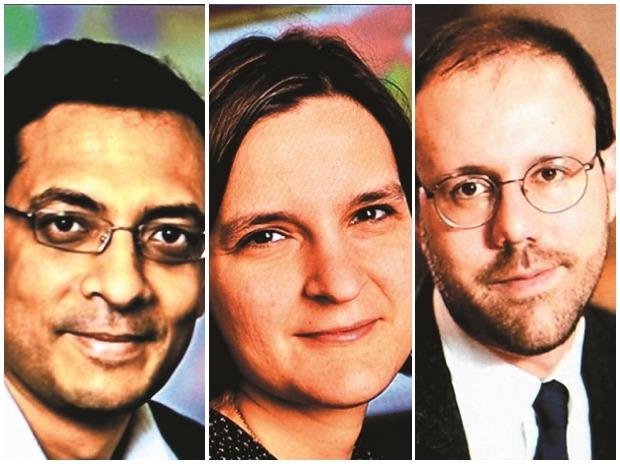
This year’s economics Nobel prize went to three worthy economists — Abhijit Banerjee and Esther Duflo of the Massachusetts Institute of Technology, and Michael Kremer of Harvard University. The prize, which was awarded “for their experimental approach to alleviating global poverty,” shows several important ways that the economics discipline is changing.
A popular conception of economists is that they’re the high priests of the free market, downplaying the role of government and giving short shrift to the needs of society’s poorest. A great many economists defy this stereotype, spending their careers studying how to uplift the poorest citizens of the developing world through government action. Banerjee, Duflo and Kremer fall into this category.
For example, all three have studied the benefits of education. Citizens of developed countries generally take universal public education for granted, along with the economic wealth that an educated populace creates. Developing countries, such as Kenya and India, don’t have this luxury. In 2003, Kremer reviewed a series of randomized controlled trials in Kenya that found that spending more on education was effective, but that health treatments like deworming were also useful for keeping kids in school. Banerjee and Duflo, along with co-authors Shawn Cole and Leigh Linden, studied a program that hired tutors for underperforming students in India, as well as a computer-assisted learning program, and concluded that both were effective. Duflo has also found big wage gains from public education spending in India, confirming the central role of schools for economic growth.
Over the years, Banerjee, Duflo and Kremer looked at programs that nudge developing-world farmers to use more fertilizer, provide microcredit to slum residents, create quotas for women in local government, provide deworming treatments for the poor, eradicate malaria, and many other targeted ...READ MORE

